Starting solids at 6 months: a gentle first-week plan
A calm, one-food-at-a-time approach to your baby’s very first spoons — what to offer, how much, and how to watch for readiness.
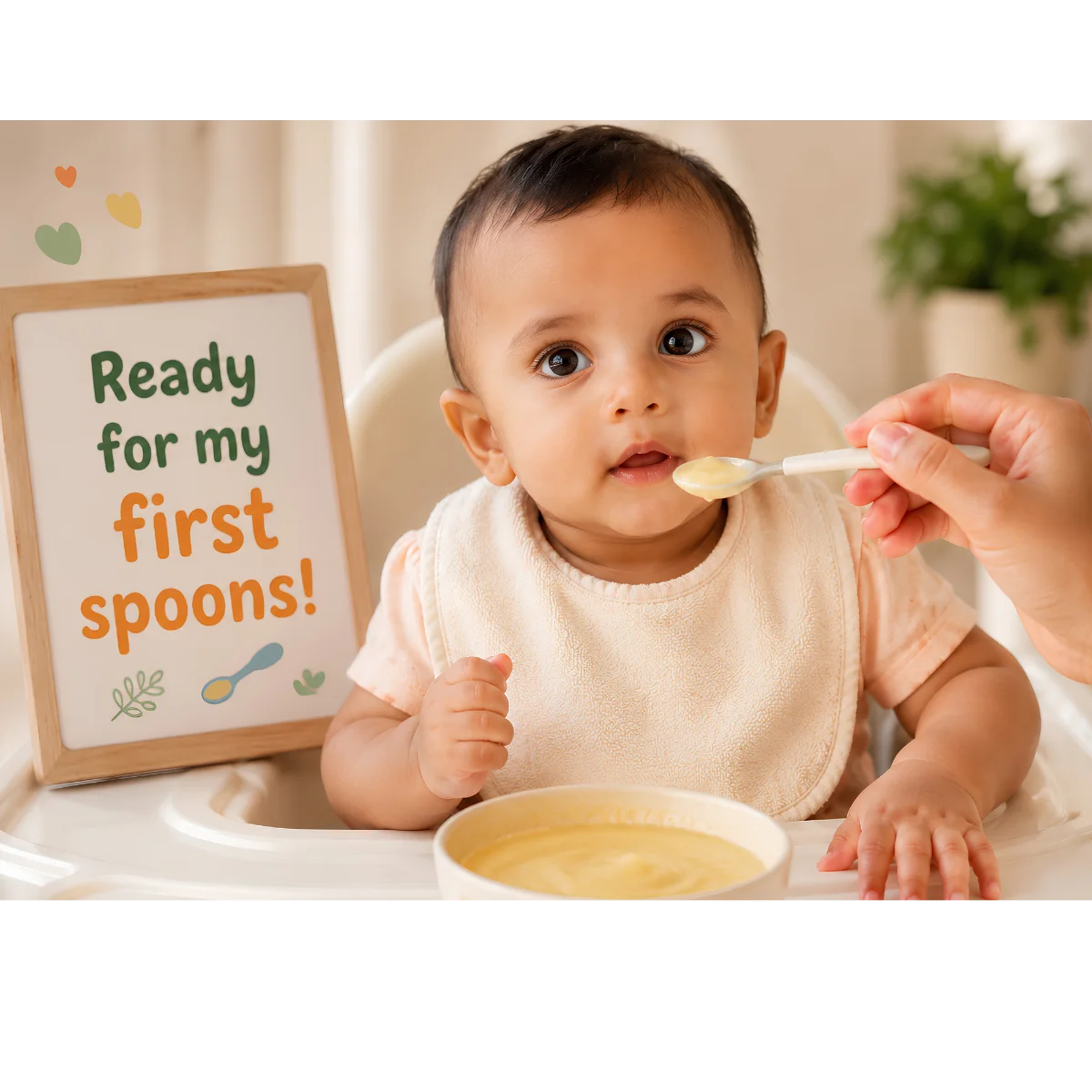
Around six months of age, most babies are ready to begin complementary foods alongside continued breastfeeding. The World Health Organization and the Indian Academy of Pediatrics both place this milestone at about 6 months, when a baby’s energy and nutrient needs — particularly iron — begin to outgrow what milk alone can provide.
Signs your baby may be ready
Age is a guide, not a rule. Alongside being around six months, look for the developmental signs the IAP describes: your baby can sit with support and hold their head steady, shows interest in food, and has begun to lose the tongue-thrust reflex that pushes food back out.
A gentle first week
- Days 1–2: Offer one or two teaspoons of a single, smooth food once a day — for example a thin, well-cooked porridge made with water.
- Days 3–4: Continue the same food, letting your baby set the amount. Milk feeds continue as usual.
- Days 5–7: If all is well, you can introduce a second single food, again on its own for a few days.
Introducing one new food at a time, for three to five days, makes it easier to spot how each food suits your baby. Start thin and increase thickness gradually as your baby grows more confident.
What to keep in mind
ICMR–National Institute of Nutrition guidance advises against added salt and sugar for infants. Prepare foods with clean water, expressed breast milk or formula — not cow’s milk — in the first year. Every baby is different; if you have any concern, your pediatrician is the right guide.
A note on our guidance. Breastfeeding is best for babies. WHO recommends exclusive breastfeeding for the first 6 months and continued breastfeeding, alongside safe complementary foods, up to 2 years and beyond. This article is general educational information in line with the Infant Milk Substitutes, Feeding Bottles and Infant Foods Act, 1992 (IMS Act) and is not a substitute for advice from your pediatrician.
- •WHO. Guiding principles for complementary feeding of the breastfed child (2003).
- •Indian Academy of Pediatrics. Infant and Young Child Feeding Guidelines (2016).
- •ICMR–National Institute of Nutrition. Dietary Guidelines for Indians (2024).
General educational information, published in line with the IMS Act, 1992 and FSSAI regulations. Not a substitute for advice from your pediatrician.