How much should my 6-month-old eat?
Small tummies, small portions. A look at typical amounts — and why your baby’s cues matter more than the number.
New eaters need surprisingly little. WHO’s complementary feeding guidance describes gradual increases in amount, thickness and variety over the months after six — always alongside continued breastfeeding.
Typical starting amounts
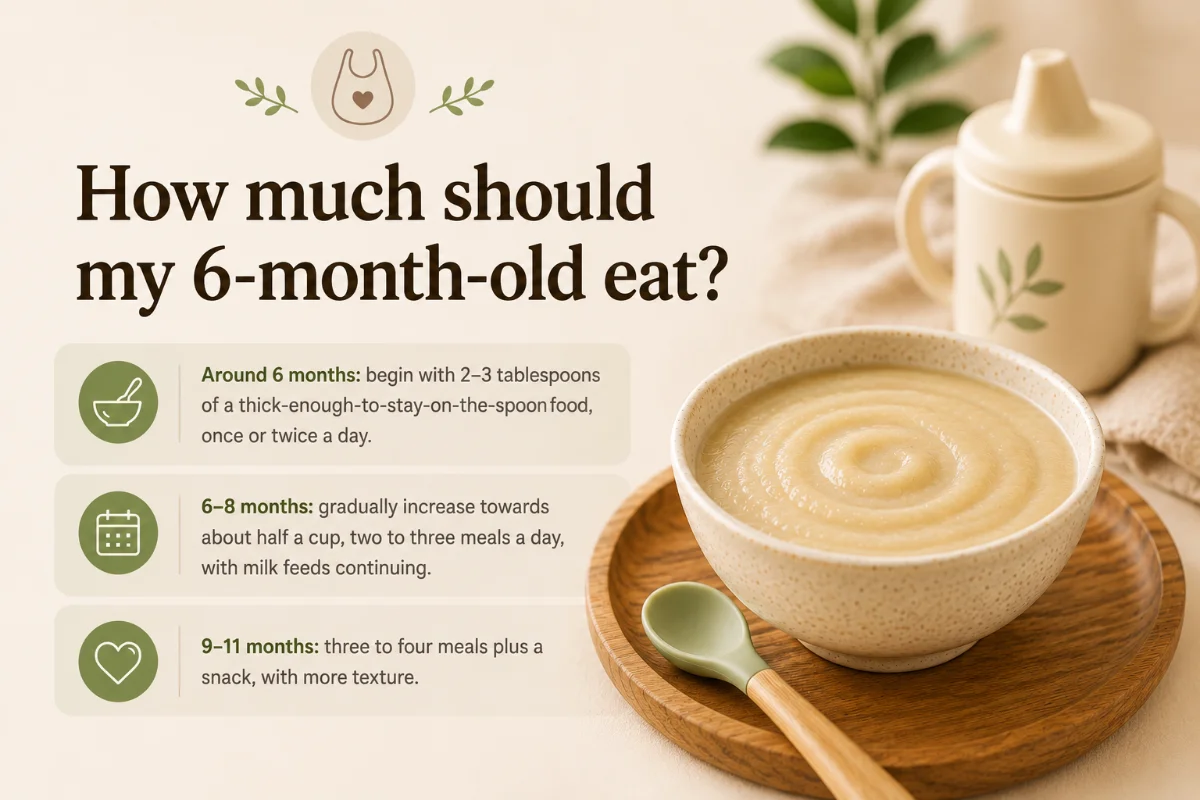
- Around 6 months: begin with 2–3 tablespoons of a thick-enough-to-stay-on-the-spoon food, once or twice a day.
- 6–8 months: gradually increase towards about half a cup, two to three meals a day, with milk feeds continuing.
- 9–11 months: three to four meals plus a snack, with more texture.
These are general figures from WHO/IYCF guidance — your baby’s appetite varies day to day.
Cues over numbers
Responsive feeding means watching your baby, not the bowl. Signs of fullness include turning away, closing the mouth, or losing interest. Never force the last spoon.
Preparation notes
Keep foods free of added salt and sugar in the first year (ICMR–NIN). Prepare with water, expressed breast milk or formula rather than cow’s milk. If your baby’s growth or feeding worries you, speak with your pediatrician.
A note on our guidance. Breastfeeding is best for babies. WHO recommends exclusive breastfeeding for the first 6 months and continued breastfeeding, alongside safe complementary foods, up to 2 years and beyond. This article is general educational information in line with the Infant Milk Substitutes, Feeding Bottles and Infant Foods Act, 1992 (IMS Act) and is not a substitute for advice from your pediatrician.
- •WHO. Guiding principles for complementary feeding of the breastfed child (2003).
- •ICMR–National Institute of Nutrition. Dietary Guidelines for Indians (2024).
- •Indian Academy of Pediatrics. IYCF Guidelines (2016).
General educational information, published in line with the IMS Act, 1992 and FSSAI regulations. Not a substitute for advice from your pediatrician.